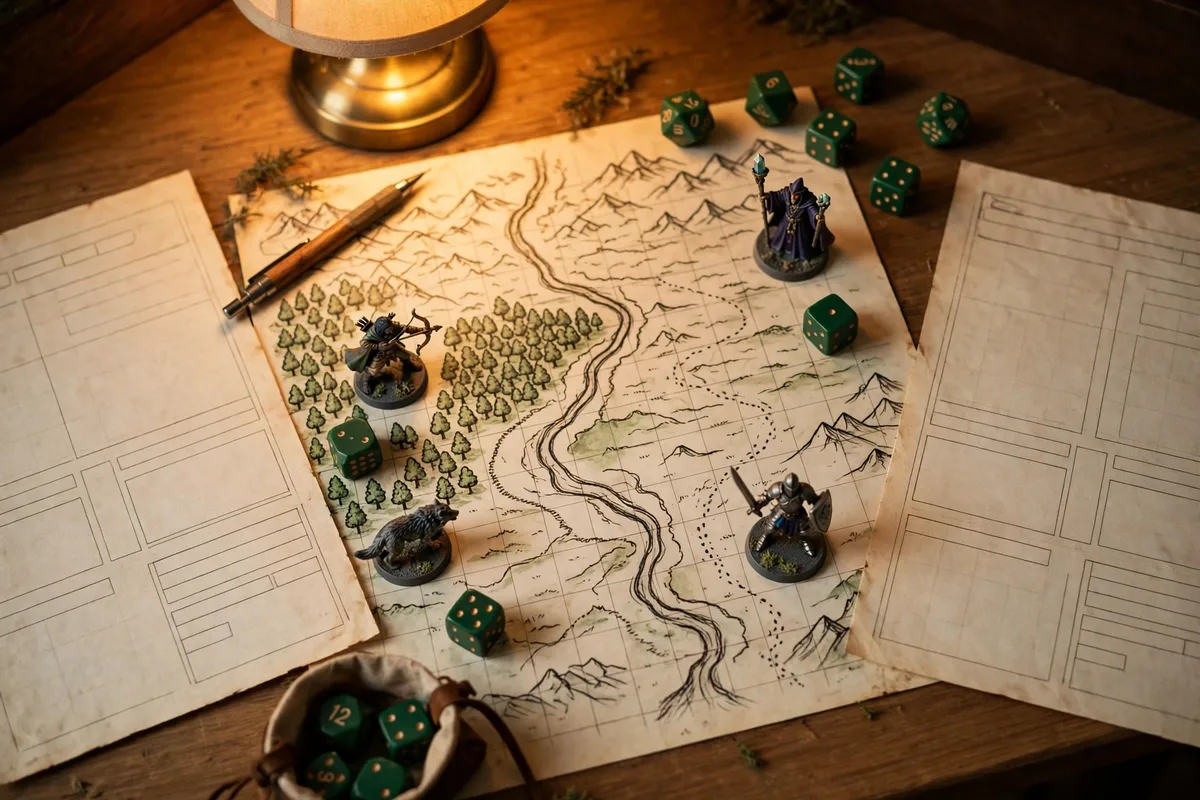
A roleplay starter is a door, not a room: it opens a scene with a hook and lets the players build the rest. The strongest starters give every character something to do in the first minute — a decision, a reaction, a secret to protect. Pick one, set the scene in two sentences, and let the players take it from there.
The 25 starters below are grouped by setting. The setting is not decoration — it decides what the characters can do, what is in their way, and why they cannot simply walk away.
How to use these starters
Read the starter aloud, then add one concrete detail: the weather, the smell, the sound in the room. Then stop talking and let the players respond. If the scene stalls, introduce a complication from the starter itself — the person who sent the letter, the thing in the pack, the bell that should not be ringing. A starter works when the players have a choice to make, not a speech to listen to.
Agree on the basics before you start: how long the scene should run, whether the players can split the party, and what happens when a character fails. A starter is a door — but the players need to know how far the corridor goes.
Starters in town
- "The door was already open when we got there." Your party enters the safehouse to find it ransacked. The hook: the ransacking is fresh, and the thief may still be inside.
- A messenger arrives with a letter sealed in black wax — addressed to the whole party, by name. The hook: the letter names all of them, and none of them sent for it.
- A festival in town; the fireworks spell out a message meant for one of you. The hook: the message is public, and the intended reader has to pretend not to see it.
- "The well is dry, the crops are failing, and the mayor is lying." A village elder corners your party. The hook: the elder is the witness, and the mayor is the suspect.
- A travelling merchant offers the party a map, a key, and a warning — in that order. The hook: the order matters: the map first, the key second, the warning last.
- The town's bell tolls thirteen times at midnight. Everyone pretends not to hear it. The hook: the pretending is the mystery — who taught the town to ignore it?
Starters on the road
- Your character wakes in a tavern they don't remember entering, with a stranger's ring on their finger. The hook: the ring is the evidence, and the missing night is the mystery.
- The map your party has been following leads to a village that isn't on any other map. The villagers are expecting you. The hook: the expectation is the trap — how did they know you were coming?
- "I know a shortcut," says the stranger. The shortcut is through a graveyard. The hook: the shortcut is the choice, and the graveyard is the price.
- A storm strands the party in an inn where the innkeeper knows all their names. The hook: the innkeeper has never met them — so how does she know?
- The party's camp is visited by a fox that sits, watches, and waits to be followed. The hook: the fox is the guide, and the following is the decision.
- "Before we go in, one of us should stay with the horses." Nobody volunteers. The hook: the refusal is the character — who stays, and why?
Starters at sea and on ships
- "We need to talk about what the captain saw last night." A shipboard scene opens mid-argument. The hook: the captain saw something, and the crew is divided about what it was.
- Your character finds their own name on a bounty board — with a reward they can't afford to ignore. The hook: the reward is the temptation, and the name is the mystery.
- Two rival guilds, one job, and your party caught in the middle. Both guilds are offering to pay. The hook: the middle is the danger, and the payment is the choice.
- A duel is declared over a matter nobody will explain — and your character is the second. The hook: the unexplained matter is the mystery, and the second is the witness.
Starters in strange places
- The party's guide refuses to take one more step past the old stone marker. She won't say why. The hook: the marker is the boundary, and the refusal is the warning.
- Your character receives a gift from someone who died three years ago. The gift is still warm. The hook: the warmth is the impossibility, and the giver is the mystery.
- Your character's reflection waves back — a second too late. Nobody else sees it. The hook: the lateness is the clue, and the solitude is the horror.
- A masked ball where everyone is someone else — and one guest is exactly who they claim to be. The hook: the honest guest is the anomaly, and the masks are the lie.
- The party finds a door in the dungeon that hums when touched. It hums a tune one of them recognises. The hook: the tune is the memory, and the door is the question.
- Your character's mentor sends a single word: "Run." The message is three days old. The hook: the lateness is the danger — three days is a long time to run from.
- The party wakes to find one of their number missing — and a trail of cold ash leading out. The hook: the ash is the trail, and the missing member is the urgency.
- "The contract says the job is done when the bell rings. The bell has already rung twice." Nobody rang it. The hook: the bell is the deadline, and the ringing is the mystery.
- Your character finds a letter in their pack they didn't write, in their own handwriting. The hook: the handwriting is the proof, and the unwritten letter is the question.
Keep the scene moving
When a scene slows down, give a player a choice with a cost: open the door or walk away, trust the stranger or don't, spend the last of the supplies or save them. Choices are what make a starter into a session. And when the players surprise you — they will — let the world react honestly: the innkeeper remembers, the guild keeps score, the fox is still waiting.
Need a scene to drop two characters into? The Scenario Headcanon Generator puts them into a what-if moment in one click. For the first meeting that starts a campaign, the first meeting prompts cover the collision; for the conversation that follows, the dialogue prompts open mid-conversation. And when your characters need habits, fears, and secrets before the first session, the Headcanon Generator builds them in seconds.